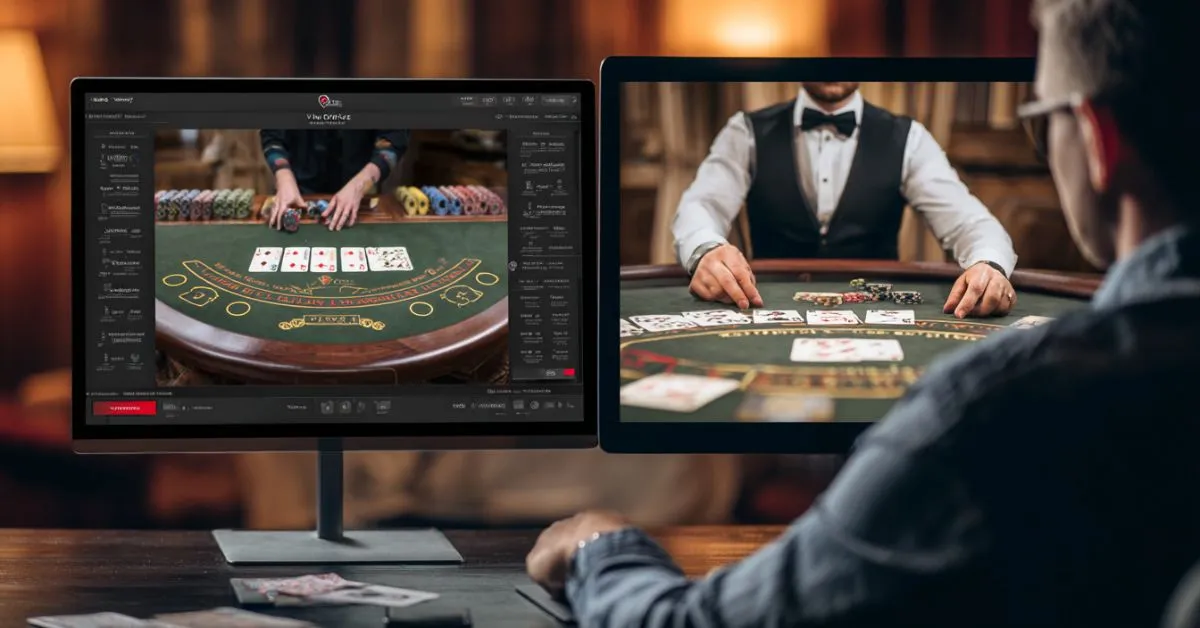
Live Dealer vs RNG Tables: Which Offers the Best Odds for Smart Players?
Most online casino guides obsess over slots and welcome bonuses, leaving table game players to figure things out on their own. Yet anyone serious about Blackjack, Roulette, or Baccarat eventually runs into one fundamental decision. Should you play at a Random Number Generator (RNG) table powered entirely by software, or take a seat at a live dealer table streamed from a real studio?
This live dealer vs RNG choice shapes your odds, your bankroll burn rate, and even how much you enjoy a session at the table. The guide below breaks down both formats in plain terms so that smart players can decide with clear eyes instead of guesswork.
Quick Comparison: Live Dealer vs RNG Tables
| Factor | RNG Tables | Live Dealer Tables |
|---|---|---|
| How results are decided | Random Number Generator software | Human dealer with real cards or a real wheel |
| Game format | Fully digital | Streamed from a professional studio |
| Speed | Very fast | Slower and human-paced |
| Minimum bets | Usually lower | Usually higher |
| Atmosphere | Solo, quiet, software-driven | Social, immersive, casino-like |
| Transparency | Based on certified software fairness | Visible physical dealing or spinning |
| Best for | Beginners, practice, low stakes, fast play | Realism, higher limits, slower sessions |
| Main risk | Fast play can drain bankroll quickly | Higher minimums and longer session times |
How RNG Tables Work
An RNG table is pure software. Every card dealt and every spin of the wheel is decided by a Random Number Generator, an algorithm that produces unpredictable results thousands of times per second. There is no physical deck, no croupier, and no wheel. When you click “deal,” the outcome is generated instantly and shown to you through animation. Grasping this software backbone is the first step in any honest live dealer vs RNG comparison.
The strength of RNG tables is consistency. Independent testing laboratories certify the algorithms, and licensed casinos cannot alter them, so the result is genuinely random on every round. The published Return to Player (RTP) percentage reflects exactly how the game performs across millions of rounds.
| RNG Game Type | Typical RTP / Return |
|---|---|
| RNG Blackjack with standard rules | Close to 99.5% |
| European Roulette | Around 97.3% |
| Baccarat banker bet | Around 98.9% |
None of these figures shift with the time of day or with how many people happen to be playing.
Key points about RNG tables:
- They are powered entirely by software.
- Outcomes are generated instantly.
- Certified RNGs are tested by independent laboratories.
- The pace is much faster than live dealer play.
- They are often better suited to low-stakes practice and strategy testing.
How Live Dealer Tables Work
A live dealer table replaces the algorithm with a human croupier, a real deck or wheel, and a high-definition video stream. You place bets through a digital interface, but the cards are physically dealt and the wheel is physically spun inside a professional studio. Optical character recognition software reads the results and updates your screen in real time, while multiple camera angles let you watch every moment of the action.
The appeal here is atmosphere and visible trust. Live tables recreate the social texture of a land-based casino, complete with dealer chat and the obvious randomness of a freshly shuffled shoe. Because you can see the deal happen, there is nothing to take on faith. Platforms such as Rexbet bring both RNG and live dealer tables together under one account, which gives players a simple way to compare the live dealer vs RNG experience without ever switching sites.
Key points about live dealer tables:
- They use real dealers, real cards, or real wheels.
- The action is streamed from a professional studio.
- Results are captured through camera and recognition technology.
- The experience feels closer to a land-based casino.
- The pace is naturally slower than RNG gameplay.
Live Dealer vs RNG: Do the Odds Actually Differ?
This is the part that matters most. For the same game with the same rules, the mathematical house edge is identical whether software or a human runs the table.
A Roulette wheel with a single zero carries a 2.7 percent house edge no matter who spins it. Baccarat banker and player bets keep their standard probabilities in both formats, and Blackjack maths does not bend for a camera.
What does change is rule consistency. RNG tables apply one fixed rule set, so the RTP you see is the RTP you get every single time. Live tables vary far more. A Blackjack table that pays 3:2 on a natural is much better for you than one paying 6:5, and the tempting side bets common on live tables often carry a house edge above 5 percent.
So the live dealer vs RNG format itself does not damage your odds, but the specific table you choose certainly can. Smart players read the rules before they sit down rather than assuming every table with the same name is equal.
| Game Factor | Why It Matters |
|---|---|
| Blackjack payout | 3:2 is better for players than 6:5 |
| Roulette wheel type | Single-zero wheels are better than double-zero wheels |
| Baccarat bet choice | Banker usually has stronger odds than many side bets |
| Side bets | Often carry a much higher house edge |
| Table rules | Can change the true cost of play more than the format itself |
The key takeaway:
The odds are not better simply because a game is RNG or live dealer. The rules decide the real value.
Game Speed and Why It Matters for Your Bankroll
Speed is the most underrated factor in the live dealer vs RNG comparison. An RNG table moves as fast as you click. A focused player can complete several hundred Blackjack hands per hour because there is no shuffling, no chip handling, and no waiting on other people at the table.
A live dealer table is paced by a human, so expect roughly 40 to 70 hands per hour depending on how full the table is. That slower rhythm has a real financial effect. House edge is a percentage applied to every wager, which means the more rounds you play per hour, the more total money passes through that edge.
A patient live table can preserve a bankroll for far longer than a rapid RNG session, even when the per-hand odds are completely identical. Players chasing volume tend to prefer RNG speed, while those protecting a fixed budget often benefit from the slower live pace.
| Format | Typical Pace | Bankroll Effect |
|---|---|---|
| RNG tables | Several hundred rounds per hour | More money exposed to the house edge in less time |
| Live dealer tables | Around 40 to 70 rounds per hour | Slower bankroll movement and longer session rhythm |
Why speed matters:
- Faster play means more bets per hour.
- More bets per hour means more exposure to the house edge.
- Slower play can help a fixed bankroll last longer.
- RNG speed is useful for practice, but risky for impulse betting.
- Live dealer pacing can encourage more deliberate decisions.
Betting Limits Compared
Betting limits are another area where the live dealer vs RNG split shows up clearly. RNG tables usually allow very low minimum bets, sometimes a fraction of a single unit, which makes them ideal for cautious players, strategy practice, or testing a new system without pressure on the balance.
Live dealer tables generally set higher minimums because every table carries real running costs, including a studio, equipment, and a salaried croupier. In exchange, live tables often raise the ceiling for high rollers and frequently provide dedicated VIP rooms with their own limits.
This matters for strategy: a low minimum lets you ride out a losing streak with a staking plan intact, while a high minimum can end a session quickly. If you want to wager small and stay flexible, RNG has the advantage. If you want a premium high-stakes environment, live tables deliver it.
| Betting Factor | RNG Tables | Live Dealer Tables |
|---|---|---|
| Minimum bets | Usually lower | Usually higher |
| Best for small bankrolls | Stronger option | Less flexible |
| High-limit play | Available, but less atmospheric | Often better suited |
| Strategy testing | Easier and cheaper | More expensive |
| VIP experience | Limited | More common |
In simple terms:
- RNG tables are usually better for low-stakes players.
- Live dealer tables are often better for high-limit players.
- Minimum bet size can affect session length as much as house edge does.
The Psychology of the Table
Numbers alone do not decide how people gamble, so the live dealer vs RNG question is partly psychological. RNG tables are solitary and silent, which helps disciplined players stick to a plan and step away exactly on schedule. That same silence, however, can encourage rapid and almost mechanical betting that quietly drains a balance before the player even notices.
Live tables introduce a human element that slows decisions down and makes each round feel more accountable. Yet the social atmosphere and friendly dealer interaction can also stretch a session well beyond what a player first intended.
Knowing your own tendencies is the genuine edge here. A player who races through RNG hands without thinking may find that a live table imposes useful discipline, while a player who lingers to socialise might stay safer with a short and contained RNG session.
| Player Tendency | Safer Format to Consider | Why |
|---|---|---|
| You bet too quickly | Live dealer | Slower pace may help control decisions |
| You get distracted by chat or atmosphere | RNG | Less social pressure and fewer distractions |
| You want to practise strategy | RNG | Lower stakes and faster repetition |
| You want a more immersive session | Live dealer | More realistic casino environment |
| You have a strict small budget | RNG or slower live tables | Depends on minimum bet and pace |
Which Should Smart Players Choose?
There is no universal winner in the live dealer vs RNG debate, because the right answer depends entirely on your goals.
Choose RNG tables when you want low stakes, fast play, a consistent published RTP, and a distraction-free environment for practising strategy. Choose live dealer tables when you value transparency you can watch with your own eyes, a richer atmosphere, higher limits, and a pace that naturally protects your bankroll.
The genuinely smart approach treats both as tools rather than rivals. Use RNG tables to drill Blackjack basic strategy or test a Roulette plan at minimal cost, then move to a live table when you want the full casino experience and the human touch.
Whichever way the decision goes for you, the winning habits never change. Understand the house edge, confirm the table rules before you bet, set a clear budget for the session, and walk away once you reach it. Format is a personal preference. Discipline is the real strategy that protects smart players.
Choose RNG Tables If You Want:
- Low minimum bets
- Fast gameplay
- Strategy practice
- Consistent software-based rules
- A quiet, distraction-free session
- Shorter and more controlled play
Choose Live Dealer Tables If You Want:
- A realistic casino atmosphere
- Human dealer interaction
- Slower gameplay
- Higher betting limits
- Visible physical dealing or spinning
- A more immersive table experience
Final Verdict
| Best Choice For | Recommended Format |
|---|---|
| Beginners | RNG tables |
| Low-stakes players | RNG tables |
| Strategy practice | RNG tables |
| Players who want realism | Live dealer tables |
| Slower bankroll exposure | Live dealer tables |
| High-limit play | Live dealer tables |
| Strict rule comparison | Either, if the rules are strong |
There is no single best format for every player. The better choice is the one that matches your bankroll, preferred pace, strategy level, and personality.
FAQs
Does the live dealer vs RNG format change the odds of a casino game?
No. For the same game with identical rules, the house edge is the same in both formats. What truly affects your odds is the specific rule set of the table you join, such as Blackjack payouts and side bets, not whether a human or software runs it.
Are RNG tables fair compared with live dealer tables?
Yes. RNG tables at licensed casinos use certified Random Number Generators that are audited by independent laboratories, so outcomes are genuinely random. Live dealer tables are fair because the deal is physical and visible on camera. Both are trustworthy when the casino holds a valid licence.
Which is better for beginners in the live dealer vs RNG choice?
RNG tables suit most beginners. Their very low minimum bets and self-paced rounds let new players practise basic strategy cheaply and without social pressure. Once the strategy feels natural, moving to a live table adds atmosphere without changing the underlying maths.
Why are live dealer tables slower than RNG tables?
A live dealer table is paced by a human who shuffles, deals, and handles chips, so it runs roughly 40 to 70 rounds per hour. An RNG table is almost instant. In the live dealer vs RNG comparison this slower speed can actually help, because fewer rounds per hour means less money exposed to the house edge.